
For Lake Hartwell homeowners, boaters and businesses, questions are stacking up. Why is the lake so low? What is the Clemson Saddle Dike? Will Hartwell ever return to the 660 foot summer level we are accustomed to seeing? And perhaps the biggest question of all: How long will these restrictions last?
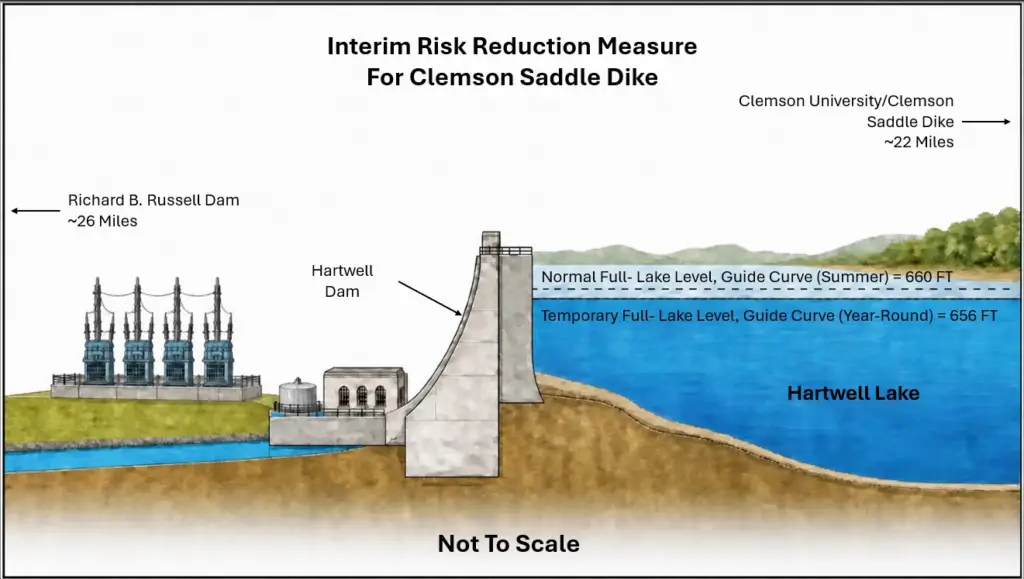
The U.S. Army Corps of Engineers announced in August that Hartwell Lake will operate under a temporary year-round target elevation of 656 feet above mean sea level while engineers work toward a permanent solution for problems at the Clemson Lower Diversion Dam Saddle Dike. USACE says there is no immediate danger to the public, but recent engineering evaluations show that action is necessary to reduce future risk.
It is important to understand that the restriction is not the reason Hartwell is currently so far below full pool. Drought conditions have already pushed the lake well below 656 feet. USACE projections in early October showed Hartwell around 649 feet, with additional declines possible if dry conditions continue. The difference will become more noticeable after the drought ends: instead of returning to the traditional summer target of 660 feet, the lake will be managed toward 656 feet year-round while the Saddle Dike issue is addressed.
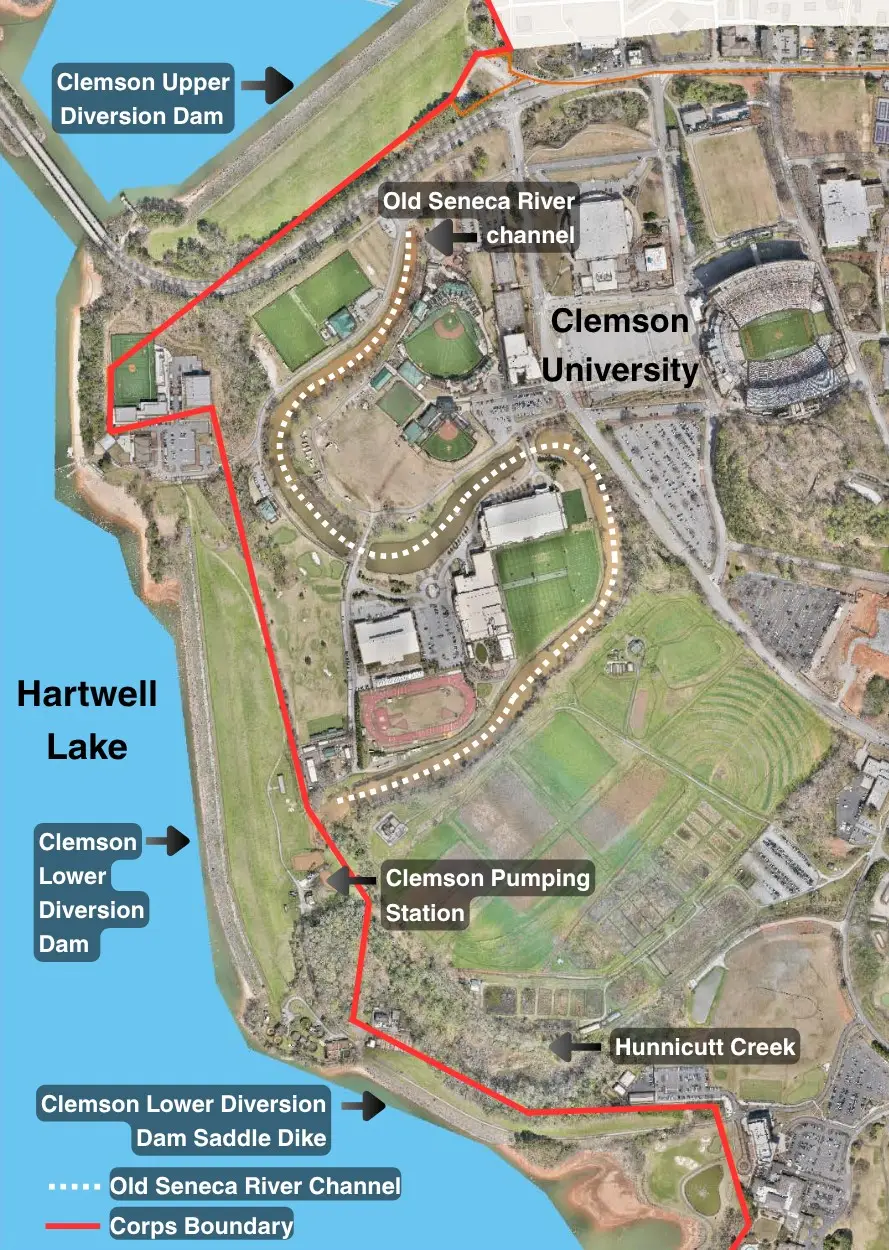
The Saddle Dike is not the main Hartwell Dam. It is part of what USACE calls the Clemson Protective Works, which includes two diversion dams and the Saddle Dike near Clemson University.
These structures were built before Lake Hartwell was filled to reroute the Seneca River and help prevent water from flooding Clemson University property. The Saddle Dike serves as a barrier across a naturally lower section of land near the Lower Diversion Dam.
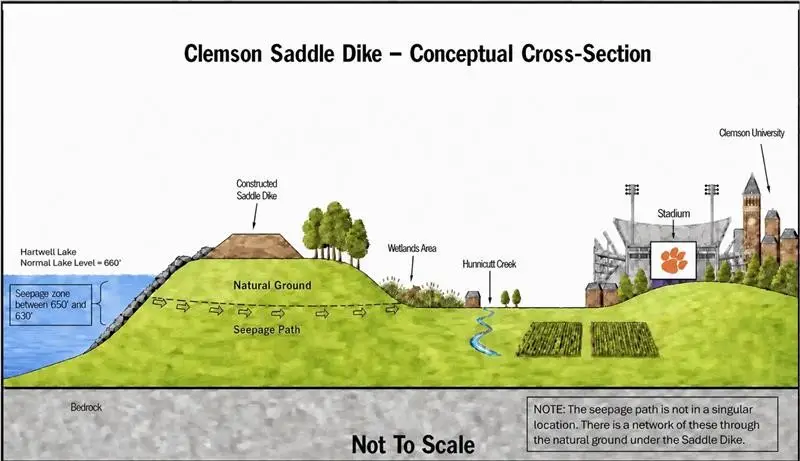
USACE has been monitoring seepage at the Saddle Dike since 2015. Engineers have observed water moving through and beneath portions of the earthen structure. Over time, moving water can carry away fine soil particles and create pathways through the dike, a process known as internal erosion or “piping.”
According to USACE, newer monitoring data, engineering analysis and observations following significant storms, including Hurricane Helene, indicate that the deterioration has worsened.
What Are the Interim Risk Reduction Measures? Until a permanent repair can be designed and built, USACE is taking several temporary or Interim Risk Reduction measures.
The most noticeable is the lake-level restriction. Hartwell’s normal operating guide curve will be held at 656 feet year-round, instead of rising to approximately 660 feet during the summer. USACE will also work to keep the lake below a maximum elevation of 662 feet. If heavy rainfall pushes the lake above the target, releases may be increased to return it toward 656 feet as conditions safely allow.
USACE is also increasing inspections and monitoring of the Saddle Dike, updating inundation maps and emergency plans, and coordinating preparedness exercises with Clemson University and county emergency officials.
For lake residents, the 656-foot target could mean shallow-water docks are dry more frequently, some shallower boat ramps may close, and designated swimming beaches may be unusable because many are affected below approximately 657 feet. The lake itself will remain open for boating and recreation, but lower water exposes rocks, stumps, sandbars and other hazards.
What Is the Permanent Solution? USACE plans to begin a formal Dam Safety Modification Study to determine the best long-term engineering solution for stabilizing the Saddle Dike.
That study is expected to evaluate possible repair alternatives before a final project is selected. According to the Corps, a Dam Safety Modification Study typically takes up to two years. After that comes engineering design, federal funding approval and construction.
That means this will not be a quick repair. USACE currently says the entire process could take five to ten years or more, although the exact construction timeline is not yet known. The temporary lake restriction is expected to remain in place for multiple years and will be reevaluated annually.
Why not simply wait? For homeowners looking at dry docks and long stretches of exposed shoreline, lowering Hartwell’s operating target can be frustrating. But USACE says doing nothing carries much greater consequences.
If internal erosion were allowed to continue unchecked, the Saddle Dike could eventually fail. A breach could flood low-lying areas around Clemson University, damage infrastructure and affect the university’s sewage treatment operations. Most importantly, it could endanger lives. Such an emergency could also require a major drawdown of Lake Hartwell so repairs could be made.
For now, Lake Hartwell residents will need patience and good information. The familiar shoreline may look different for some time, but the goal behind these restrictions is straightforward: reduce pressure on the Saddle Dike today while engineers develop a permanent solution for tomorrow.
Lake Hartwell remains open, active and very much a part of our community. Understanding why these changes are happening can help all of us adjust while protecting the lake and the communities surrounding it for years to come.